Author: James Willmus

  • Beating a Dead Horse: NCE or Digitrax?

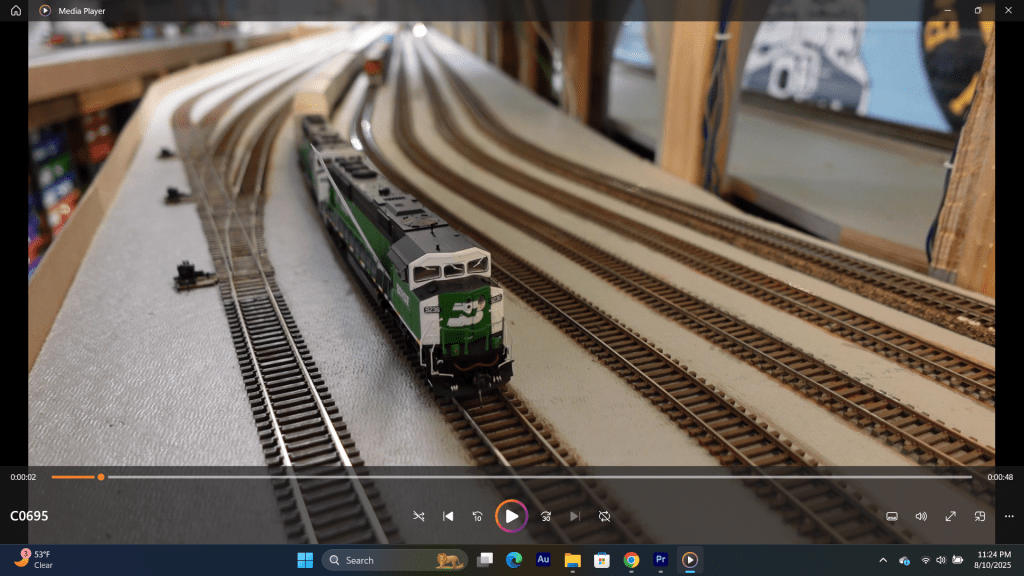
    One of the most frequently asked model railroad questions on the web is “Should I buy NCE or Digitrax?” I have a question in return, why? This has been a topic that has been had since the mid-2000’s when both companies first released their respective starter DCC systems. Comparing the two companies has resulted in many arguments and ended friendships, yet people still want to know which system they should invest in. Well, Jordan and I put together a video to sort it out. We thought it would only be about ten or fifteen minutes, but it turned into a forty-eight minute long discussion comparing the two systems. I highly encourage people to go watch the video, but for those of you who don’t have that much time, this article is a summary of our thoughts.

    What is DCC?

    Before going into the systems themselves, we ought to clarify what DCC is. Digital Command Control (DCC) is a technology that is now in its fourth decade of existence and it has become the control system of choice for most model railroaders. DCC uses electrical signals mixed with DC current to communicate between a command station and locomotives on the track. Each locomotive is assigned its own number, usually the locomotive number on the cab, and signals which are not meant for a certain locomotive do not trigger a response from any engine except for one with that decoder number.

    DCC is also a one-way communication system. Signals are sent to decoders which respond to commands, but they don’t talk back like how components communicate within a computer. Radio Control works in a similar way, except that model railroaders have the advantage of always running their trains on metal rails which can carry electrical signals more efficiently than radio waves. The end result is that DCC systems allow model railroaders to run multiple trains at once on the same track without interfering with each other. DCC not only saves on wiring and the complexity of block control, but also offers model railroaders more features than hobbyists in the past could ever dream of!

    NCE Power Cab vs Digitrax Zephyr Express

    Convinced you want to invest in DCC? I don’t just throw the word “invest” out there to sound smart (okay, maybe sometimes), getting into DCC is indeed an investment. Every locomotive will need a decoder and the upfront costs are at least double that of buying an analog DC controller. Looking at the market, there are a lot of options available, but the two most common are offerings from NCE and Digitrax and hobby shops will stock at least one of these two systems.

    The NCE corporation produces a basic DCC starter system called the “Power Cab” which has been in production since 2006. Retailing with an MSRP of $249, this system can typically found for just under $200 if you know where to look. The handheld throttle doubles as a command station which differs from the more advanced DCC systems out there which has a command station located somewhere on the train layout. This means that you cannot unplug the Power Cab and move to another phone jack without also losing power to the train layout. The good news though is that with the addition of more throttles or a WiFi system, its possible to use throttles with the Power Cab and walk around with trains as they run instead of being limited to the length of the cable tether.

    Digitrax came out with its original Zephyr at about the same time as NCE’s Power Cab, but in 2019 the system got a much-needed update. The Zephyr Express came out in January of 2019 and features soft-touch buttons and a backlit LCD screen along with a throttle similar to that of an old power pack all in a single device that can be mounted somewhere on the train layout. The issue with this system is that more throttles are needed to move outside of arms’ reach of the command station / master throttle. The good news though is that since the Zephyr Express doesn’t need to fit in the palm of one’s hand like a TV remote there is room inside to boost the amperage all the way to 3 Amps, which in this day and age is going to be five or six DCC-equipped HO scale locomotives.

    The two systems are very comparable to each other outside the obvious differences in design philosophy, but here’s a breakdown as to where one system outshines the other:

    Price

    Both the Power Cab and Zephyr Express can be found at right around the $200 mark and their MSRP is only about $10 apart, which these days isn’t a whole lot. That’s what, three candy bars? A large iced coffee? So the two starters systems are in a dead heat with each other in terms of price and it shows just how far a little competition goes in a small industry like model railroading. Due to each other’s presence, the price stays low enough that someone can easily get started with either DCC system.

    Where the two companies diverge in price is in the higher-end products. Digitrax takes a clear win here with a fully modular approach that allows a customer to build the system which suits their needs. NCE also has a modular system of components but they don’t always play together seamlessly. More importantly, the price of NCE components tends to be more than that of Digitrax. The point then must go to Digitrax for its better value for money.

    User Interface

    Jordan and I agree that NCE really shines in terms of how easy it is to pick up and understand the basics of the system. People from all ages can easily learn how the Power Cab works and many of the functions translate directly to the bigger Pro Cab systems. In fact, I can take my Power Cab and use it as a regular throttle on a bigger NCE system. That is something which is more difficult to do with the Zephyr Express which might lead some people to conclude that they should just bite the bullet on a bigger system and skip the Zephyr completely.

    The shape of the throttle and the button layout on the Power Cab is also very well done and hasn’t changed in a significant way since the system’s introduction nearly twenty years ago. To be fair to Digitrax, in 2019 and 2020 the company did an overhaul on many of its products and now Digitrax throttles have integrated some features found on NCE throttles including better ergonomics and soft touch keys in a simple layout that is more intuitive. Even so, NCE is still the better of the two systems in this category.

    Capabilities

    Just how much can you do with DCC? That’s what this category is all about and Digitrax takes this one without much debate. NCE can do a lot of things, but when it comes to more complicated tasks like designing routes with JMRI or putting in a fully automated signaling system, we’ve found that Digitrax is simply the better system.

    Expansion

    Jordan may disagree on this and I will concede that it is situation dependent, but between the two systems NCE just feels like the better system when it comes to expansion. Digitrax is more customizable, but if you are starting with the Zephyr Express you are going to always have one throttle (the Zephyr) which is at a fixed location on the train layout. Sometimes that isn’t a big deal, but other times it is a problem, and that situation specifically is when you want to go play with other people on a larger train layout. The Power Cab’s ability to also act as a mobile throttle gives it an edge here, though I will admit that it is a small edge. When it comes to building a large DCC system, Digitrax’s larger variety of products gives it more options for expansion, but a caveat there is that Digitrax throttles have undergone about three major overhauls whereas NCE throttles have remained pretty much the same. If you have an older Digitrax system and want to update your throttles, you’ll either need to run two radio systems in parallel or you will have to retire all your throttles at once and then purchase new ones.

    External Capabilities

    To put it simply, if you are wanting to supplement your DCC system with third party options, then Digitrax has more products on the market which play well with its system. NCE has its own corner of the market too. For instance, WiFi-Trax out of Australia makes a WiFi throttle board that can communicate with phone apps, giving users the ability to easily control their trains with a smartphone instead of a dedicated throttle. Digitrax though has all that and more.

    Which one should I buy?

    That is the question we asked ourselves and to be honest, if we were both operating completely independently of a club, then we both would likely have Digitrax systems. I personally would opt for the more advanced system options with walkaround capabilities, but Jordan is quite happy with his Zephyr Express. The reason why I own an NCE system is because my local train club, the Black Hills Railway Society, uses the NCE system for its club layout. You can check out the organization on their Facebook Page: https://www.facebook.com/BlackHillsRailwaySociety

    Jordan’s local club operates Digitrax and so that just makes that company more attractive to what he needs. That club is the James Valley Model Railroad Association: https://www.facebook.com/JVMRRA/

    The two systems are indeed quite comparable to each other beyond these differences so really it is a matter of personal preference or what other people are using in your local area if that matters to you. I know for my Black Hills and Fort Pierre railroad I won’t be using either system since that will be an island unto itself. But then again, perhaps a Zephyr would be more user-friendly down the road when that layout is inherited by a museum or gallery? Well, that’s a whole different can of worms and I’ll leave it at that for now.

  • Traction Action in Fort Collins

    Willmus, 2025.

    One thing I often like to do on roadtrips is estimate the modeling potential of different areas. Scarcely a trip goes by where I come up short in finding something railroad related that is interesting, unique, and highly modelable!  On this latest summer road trip, we visited several places known for their railroad history and we ran across a few gems which will be the focus of their own articles.  Fort Collins, Colorado isn’t often considered to be a railroad town.  To be sure, Colorado is the capital of narrow gauge railroads in the western US and the state boasts rail lines that run through some of the most scenic areas in the United States. A local group in Colorado is reviving a bit of railroad history that’s unique in the 21st Century, streetcars!

    History

    1924, Miller Family Collection, Fort Collins, Colorado.

    Fort Collins, like many small cities in the western US, had a streetcar system at one point.  From the late 1890s until the Great Depression, cities such as Gillette, Wyoming and Missoula, Montana had small streetcar systems that made public transit fast and easy.  Electrification was perhaps the biggest sign that the old west full of cowboys and outlaws was giving way to a more “civilized” age of industry.  Fort Collins was no different in that respect. Founded originally as a military outpost in 1864, the old fort was constructed to protect the Overland Trail mail route in the area from bandits and natives.  What followed was typical of western cities.  The population grew and settlers brought agriculture and industry to the area, tearing up the high-plains and river valleys at the foot of the Rockies.  By 1900, Fort Collins had a population of 3,000 people.

    Wikipedia, 2025. Fort Collins Municipal Railway Timelapse 1908-1986.

    In 1907, the Denver and Interurban Railroad, which itself was a subsidiary of the Colorado and Southern Railroad out of Golden, built the initial trolley system in Fort Collins as the railroad attempted to expand operations along the front range of the Rocky Mountains.  From 1907 until 1918, the Fort Collins system operated well but the automobile was eating into profits and the system closed at the end of 1918.

    In 1919, the city of Fort Collins purchased the streetcar system and revitalized it with some track upgrades and by purchasing small Birney streetcars which could be operated by a single person.  The system eventually expanded to include a total of nine Birney streetcars running on 6 miles of track that sprawled out in a 3-legged wye.  The backbone of the system was Mountain Ave, part of which is now reconstructed and in regular use.  The streetcar system would operate until 1951.  Here there is a small error on the organization’s website.  Fort Collins may well have been the last city to operate single truck Birney trolleys, but I happen to know that Minneapolis-St. Paul ran a streetcar system until 1954.  It’s a small detail, but an important one to consider for anyone wishing to model a streetcar system instead of the typical railroad.

    In any case, the Fort Collins streetcar network ceased operations in 1951.  In 1977 a small group of volunteers began restoring Car No. 21 which had been put on static display at a local museum.  These volunteers would go on to form the Fort Collins Municipal Railway Society in 1980.  The organization continued to grow and gain support before relaying track down a section of Mountain Ave in 1984.  This operation was met with resistance by citizens concerned about hazards, noise, and tearing down trees which had grown up in the street median over the years.   The line, which runs down part of West Mountain Avenue and has a short leg down South Roosevelt Avenue into the City Park, has been turned over to the city while the FCMR Society focuses its efforts on restoring streetcars and other pieces of equipment.  For a more comprehensive description of the streetcar system’s history, please visit the FCMR Society’s website.

    Riding the Fort Collins Trolley

    Willmus, 2025

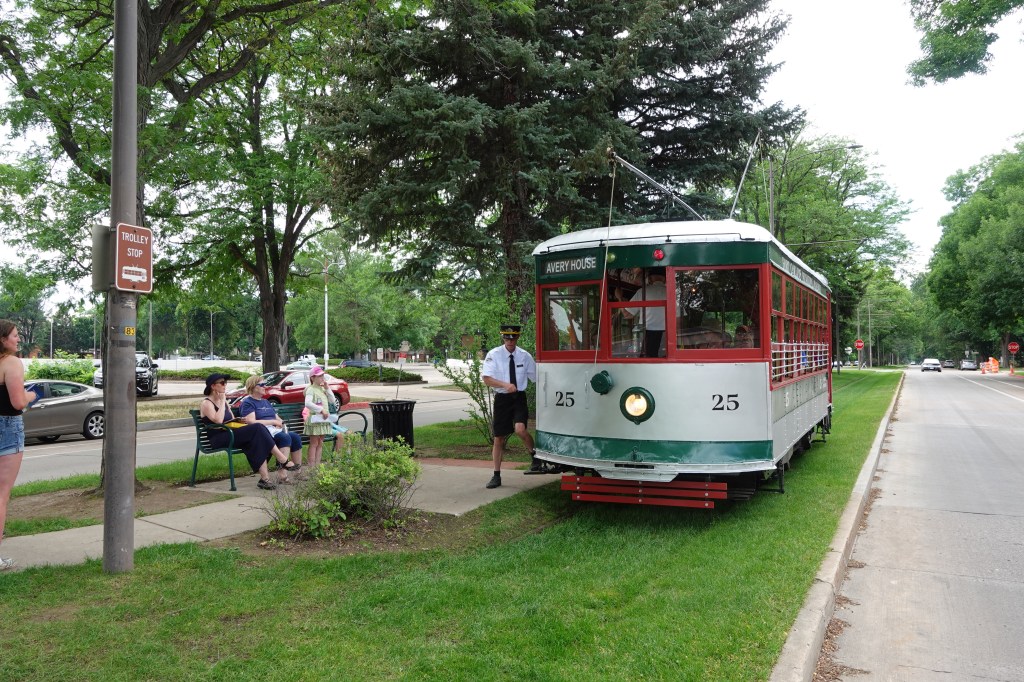
    There are many heritage railways in Colorado and many more across the United States.  Each one offers its own unique experience, but I think the Fort Collins Trolley is truly a one-of-a-kind. Since the 1950s, American public transit has shifted to a model that focuses around buses, carpool lanes, and larger cities boast light rail systems.  It is rare to find a heritage railway that has managed to relay track down the middle of a busy suburban street flanked on each side by houses that were built in the 1900s, 1910s, and 1920s.  That is precisely what the Fort Collins Trolley offers visitors.

    As of this season, the trolley operates from May 3rd to September 28th every half hour from noon to 5pm on Saturdays, Sundays, and Holidays. The fare is all of $2 with reduced rates for seniors and children.  Toddlers are free to ride with an adult.

    Just like the original line, riding the modern rails is an odd experience.  When people think of railroads they usually picture machines that weigh hundreds of tons effortlessly gliding over glass-smooth track.  Trolleys are nothing like that, however. The streetcars are about as big and heavy as a small transit bus and the rails follow the path of a paved roadway.  That means the streetcars bob and weave as they roll down the track. The streetcars also stop at every intersection and slow down for curves but manage to maintain about a 12mph average.

    The sounds are unique as well.  Trolley poles maintain contact with overhead wire using small electrically-conductive wheels.  The pole itself is spring-loaded, which puts tension on the overhead wire.  As the trolley moves down the track, the sound of stretching metal can be heard up and down the line.  The closest I can liken the sound to is that of someone plucking a strand of barbed wire on a fence.  The vibration and noise travels down the wire rather than making a single percussive wave.  Besides the wire, the trolleys themselves are nearly as quiet as a car.  All that is heard is the hum of two electric motors which sound similar to modern electric cars.  The trolleys are equipped with a bell too.

    The streetcar system also operates a very unique railfanning experience.  Since the trolley runs  on a predictable schedule along a route that for all intents and purposes is a paved street, there is no need to hurry or break traffic laws.  I found it very easy to leapfrog the trolley about three times per run, the biggest hazard being the potential of being hit by a car while exiting my vehicle.  The grassy median and the sidewalks on each side of the street provided ample opportunities for photographs.  Indeed, this is one of the few times where I could go grab refreshments from a street vendor while waiting for the trolley to come back around!

    I found West Mountain Avenue to be the perfect backdrop for the trolley.  Large, mature trees lined the street, a steady mix of vehicles, bicyclists, skateboarders, and pedestrians kept things interesting.  Houses on each side of the street were all historic with some renovated in ways which compliments their history.  The corner of West Mountain Avenue and South Roosevelt Avenue was probably the best place to sit and wait.  The trolleys there have to slow down for the curve which brings with it yet another unique sound of wheels rubbing against rail.  Admittedly, that sound is less pleasant that some of the others one can hear trackside.  I happily spent three hours photographing and filming the streetcar as it rolled up and down the line.

    Modeling Potential

    Willmus, 2025.

    While I am a fan of traction railroads, the fact is streetcars appeal to a small minority of model railroaders.  It is understandable why this is.  First, old streetcar networks are close to falling out of living memory.  Streetcars are no longer culturally relevant in a modern, car-reliant society.  Most Americans also do not have much experience with any sort of rail-based public transit, so there isn’t much of a personal connection with streetcars for most people.  Operators may find streetcars to be boring as well if they enjoy picking up and setting out cars or moving whole trains over a main line.  Trolleys run the same routes on predictable schedules and usually do not handle freight or mail.  Some systems did have those services, but they were secondary to transporting people.

    Nonetheless, there are a couple of reasons why someone would consider modeling a traction line.  The first is that trolleys are unique pieces of railroad equipment.  To most people, diesel locomotives all look similar and the same can be said with steam locomotives.  The general population simply isn’t that familiar with trains.  However, streetcars have very unique designs and paint schemes that make each stand out.  People who watch a traction layout in action are easily able to pick up on the fact that there are different cars on the route.

    Another reason someone might want to model a traction railway is that it is possible, and perhaps even preferred, to automate such a model railroad.  Streetcars frequently stopped at random locations by being flagged down by riders and they made scheduled stops at the end-points and mid-points of their routes wherever two or more cars would cross paths.  With DCC, JMRI, solid state electronics, and all the modern technology we have today in the hobby it is possible to build a model railroad that essentially runs itself.

    Some streetcars are easy to purchase ready-to-run, especially the Birney streetcar. What is convenient about Birney streetcars is that they were mostly all the same design, meaning a paint job is all that’s required to customize the model. Bachmann made a Birney model up until about 2020 and they can be found used on auction sites and train shows frequently. TSG Multimedia did an excellent product review back in 2017 of this model and you can check it out below. I also recommend subscribing to the channel!

    TSG Multimedia, 2017

    Operators aren’t left out though because an operating session on a streetcar line would be a very unique experience.  Instead of picking up and setting out cars, streetcar operations revolve around keeping to specific schedules and adapting to things like traffic, pedestrians, and riders wanting to get picked up or dropped off in different locations.  Operators on the same track must also be aware of each other and communicate clearly to avoid accidents or making each other late.  If a typical freight railroad operating session is like a big game of chess, then I imagine an operating session on a traction layout would look like a choreographed dance.

    I think the biggest advantage of modeling a traction railway is that much of the focus is on modeling realistic city scenes that are often left out of layouts modeling freight railroads.  The modeling potential is less focused on trains and more focused on structures, figures, vehicles, and small scenes that make train layout feel realistic.  The trolleys themselves are unique pieces that often require kitbashing or scratchbuilding, but there are commercial products available as well.

    One advantage I see in modeling a traction railway is that a person doesn’t need a lot of space, even, in large scales.  O scale (1:48) is traditionally the size modelers gravitate towards for building traction layouts, but in HO scale a layout can be very small indeed!  Most streetcars were designed to navigate 50 foot turns with Birney trolleys able to navigate even tighter radii.  In HO scale that works out to 6.875 inches (175mm)!  A 16 inch deep shelf can easily accommodate a full turn back loop while a 12 inch shelf offers ample depth for structures and streets.

    Conclusion

    I suppose the conclusion of this article are two separate thoughts.  The first is that if you are in the Fort Collins area in the summer on a weekend afternoon, stop by the Fort Collins trolley and spend a couple bucks for a ride.  They have a little depot as well which is used as a ticket booth and gift shop.  Every little bit helps!  The second concluding thought is that if you are short on space and prioritize model building over switching operations, a traction layout is an awesome concept worth exploring!

  • Model Train Podcasts: What do I listen to?

    TV killed the radio, or so they say. But what if radio didn’t die, it just moved online? That is essentially the concept behind a podcast. They can be live or prerecorded. They can be audio only or they can be videos. However, all podcasts share the same basic concept; individuals making their own radio show that can be shared across the world through the internet.

    One advantage podcasts have over traditional radio is that a podcast can be about almost anything. There are 4.4 million registered podcasts globally as of 2025 and is not a $3 billion dollar industry. Podcasts are growing in popularity as well since people can listen to conversations about their favorite subjects anytime they want. Podcasts offer the same benefits for model railroaders as well. Obviously, there’s not enough time in the day to listen to every minute of every podcast on a relevant subject. That’s why in this article I’d like to briefly explain three podcasts which I regularly listen to; The Around the Layout Podcast, What’s Neat with Ken Patterson, and the Second Section Podcast.

    Hosted by Ray Arnott and Don Irace along with Paul Cassar acting as the producer, the “Around the Layout” podcast was created as a way to connect with people in the hobby in the post-pandemic era. Based out of New England, the Around the Layout Podcast has been going strong now for over two years putting out audio podcasts about once per week. Each episode is between a half hour and an hour in length, making these podcasts perfect for a commute to work or for easy listening while at the workbench on a Friday night. Since this podcast is audio-only, the files are easy to download and listen to later. Using the Facebook pages as a metric, the Around the Layout podcast has an audience of between 1,500 and 2,500 people.

    The original model railroad podcast, Ken Patterson has been producing “What’s Neat” for over a decade. Originally, “What’s Neat” started as a monthly video produced by Ken Patterson for the digital-only Model Railroad Hobbyist magazine. As the segment gained popularity with readers, these “What’s Neat” segments became longer and more detailed. About seven years ago, “What’s Neat This Week” became a separate podcast on Ken Patterson’s Youtube channel. Ever since, new episodes have been coming out once or even twice a week alongside video segments for MRH magazine every month. All in all, Ken has put a lot of work into making what is easily the biggest model railroading podcast out there.

    Viewership for podcasts are several thousand while MRH magazine’s segments get 10-15k viewers each month. Size isn’t everything, but it is indicative of the podcast’s quality. Ken makes an effort to get multiple guests on per month and has a rotation of different segments and even videos in the field from large events in the Midwest. Since the podcasts are all video-oriented, they are more difficult to listen to while driving or on the go, but they can be downloaded for things like airplane flights, riding shotgun in a car to the next train show, or while sitting at the workbench at home. What I especially like about “What’s Neat” is the emphasis on how-to subjects and other information which is difficult to communicate via articles.

    Hopping on the bandwagon about three years ago, two Wisconsinite model railroaders, Andy Dorsh and Mike Ostertag decided to launch a long-format livestream podcast that has proven to be a very successful formula for model railroaders. In its current format, each episode is approximately two hours long and goes live every other Thursday. Episdoes feature either one big-name guest like Lance Mindheim or several model railroaders. I myself have appeared in one episode and a “brew with the crew” special this past winter.

    If you are looking for a podcast to sit and listen or watch for a long, uninterrupted period of time, The Second Section is precisely what you are looking for. Between the helpful advice and the intriguing discussions, there is also a kind of camaraderie that is rarely seen in online communities. The “section crew” currently boasts over 1,600 members on Facebook. Each livestream regularly gets about 160 people tuning in and then after the fact it is not uncommon for episodes to surpass 3,000 views on the Youtube channel alone.

    So, which one is the best?

    At the risk of delivering a cop-out answer, the honest truth is that it depends. If you like watching videos, then “What’s Neat” and “The Second Section” are going to be the obvious choices. If you don’t have a spare two hours to sit down and listen to model railroaders talk about their hobby then the “Second Section” isn’t going to be for you. If you are looking for clear how-to presentations, then Ken Patterson has you covered with both his podcast and the MRH monthly videos he produces. My recommendation is to give each one a try and then pick one to focus on. For me, that is the Second Section because Andy and Mike are delivering content at such a rate that I can barely keep up. The online community is very supportive as well and fun to be involved with.

    Whichever one you go with, one thing I do want to mention before closing this essay out is that each of these podcasts rely on community support in order to stay in operation. If you are a regular listener, have a few spare dollars, and know where to send the money then please give them a tip. Podcasts are just one piece in a much larger hobby, but that piece is key to moving away from traditional media formats and building an online community for all model railroaders.

  • 5 Reasons to Build a Small Layout

    After passing Pierpont Lake, the duo race a summer thunderstorm back to town.

    The first rule of model railroading is have fun.  This is a hobby, after all, and so it makes no sense to turn something fun into difficult work.  With that in mind, the second rule of model railroading is that it’s your railroad and you can do whatever you want with it.  I suppose if we added a third rule it would be to treat others with respect (looking at you, Modeler’s Life), but beyond that there really isn’t too much in the way of rules to follow.

    Naturally, a lot of people in the hobby have a dream of building a gigantic model train layout in their basement, a loft in their garage, or even a separate building.  Many such layouts have been featured in printed and digital media and I can understand the appeal.  Large layouts are a sign of discipline, education, and the accumulation of many years of knowledge about railroads, model trains, and a dozen other skill sets.  However, most of us likely aren’t going to have the chance to build something that big and those who do get the chance might want to consider a few things before breaking out the wood saw.

    The case for a modest train layout

    The fact is most train layouts aren’t particularly large.  The 4’x8’ layout in O scale or HO scale was the standard for decades, and while preferences have changed for how layouts are designed, the amount of space available really hasn’t.  The average train layout today can comfortably fit in a spare room and that’s likely all the room most people have to spare for their hobby.  A number of people have even less space, perhaps only one or two walls of one room that is used for other things, or maybe even a closet!

    Some things we can’t change and space is one of them.  Odds are that even if you move to a new house you and the family aren’t going to place high priority on finding as much space as possible for a train layout.  I mean, you might, but that would be an exception rather than the rule.  With that in mind, modest train layouts have plenty of benefits!

    1. Cost savings

    Train layouts that are on the small side are much more affordable than the basement empires we see in magazines or on Youtube. The fact is most people don’t have a lot of extra money these days to dedicate to leisure activities and at the same time model railroad equipment has gotten more expensive.  By focusing on a smaller layout, overall costs of construction can be brought down in terms of raw materials and equipment.

    2. Efficient Design

    A smaller area to build a train layout requires an efficient track plan in order to maximize the utility of the space. Larger layouts have a tendency to turn into a “spaghetti bowl” or they end up having more track than necessary in order to fill out the space. This doesn’t happen all the time, but it is a noticeable trend that shows up in a lot of the more classic designs. Now, that doesn’t mean you can’t build a model railroad that way, but most people who are low on space are going to think long and hard about what they want to include on their layout. As a result, there is usually a minimum of track and turnouts, key industries that don’t waste space, and other layout design elements that do their job well without wasting materials.

    3. Quicker Construction

    There’s only so much time in the week to dedicate to building a model railroad.  Between work, family, volunteer projects, and all the other things which occupy life, most people only find a few hours a week to enjoy a hobby.  With that being the case, wouldn’t it be great to get a train layout up an operating quickly?  Small train layouts are faster to build as a side effect of having less material to deal with.  Laying fifty feet of track is quicker than laying two hundred feet or more! Building a dozen model kits is faster than building three or four dozen. Wiring two locomotives for DCC takes an afternoon.  Wiring two dozen locomotives takes weeks to complete.

    4. More Details

    Model builders hold detail in high regard.  In fact, behind the smoothness of rollingstock and locomotives, a model’s details are what model railroaders focus on when purchasing a new piece of equipment.  If you only need to buy or kit bash a few items then you can invest more money into those items.  Additionally, fewer square feet to add scenery means it is easier to add a higher level of detail to a train layout.

    5. Comfortable Environment

    This last one is often overlooked by magazines.  Having a train layout is great, but if there is no place to sit and relax then people aren’t going to want to spend much time in the layout space.  Model railroaders in the modern day are also often renters or are purchasing a home with fewer bedrooms.  In such cases it is often unrealistic to expect a train layout to take up a large amount of real estate.  Instead, a small train layout can open up enough space for couches, TV’s, spare chairs, a kitchenette or coffee maker, and all the other creature comforts that make the hobby more enjoyable.

    Modest Layout Examples

    Of course, the first rule in the hobby is, again, its your railroad and you can build it how you want. We’ve all taken this to heart by building layouts that meet our needs without taking up so much space that it intrudes on the rest of the household or spills into our day jobs. That, I think, is a key thing to keep in mind about hobbies. They are meant to be enjoyed, but in order to enjoy them to their maximum potential we also must be able to take a break and not have to think about our modeling projects for short periods of time. Just like everything else, model trains are best done in moderation That’s why a layout is generally not placed in the living room but is instead out in the garage, down in the basement, or even in a dedicated structure.

    Anyway, in order to show what can be done in a modest space, I have a dedicated gallery of sample images from three train layouts. My own Black Hills and Fort Pierre, Jordan Schmieg’s Milwaukee Road Minnesota-Dakota Division, and Mike Thoreson’s TC&W Lakeville Sub. Each image has an included caption with information about what you are viewing so I encourage you to take a stroll through these digital galleries:

    Mike Thoreson’s Lakeville Sub

    Mike is a busy guy. Between work, raising a family, and being the president of the Black Hills Railway Society, there isn’t much room in the schedule for model trains. However, he did find space in the back of his basement to build a small train layout that satisfies his needs, provides storage for his model trains, and a workbench from which he produces some fantastic models! The Lakeville Sub models a small section of Minnesota in the late 1990s and features equipment painted in BNSF and Twin Cities and Western (TCW). The layout is a walk-in shelf design which features a large operating pit and shelves around 3 walls plus a peninsula. It does not have continuous running, but for a one or two man operating crew that is hardly an issue.

    Jordan Schmieg’s Milwaukee Road Layout

    Jordan Schmieg also lives a busy life and his is just getting started! Graduating from the South Dakota School of Mines and Technology this spring, Jordan is looking forward to applying his degree in useful ways as well as finishing his home layout that depicts the Milwaukee Road transcontinental line in the 1970s. Like most model railroaders, Jordan prefers to model in HO scale since it gives him the opportunity to use prototypical equipment for his area and era. In this case, Jordan has a pair of SDL39s plus GP40s and SD40s. He also has some modern BNSF and steam locomotives on his roster as well. Jordan’s main operational interest is whole-train movements which presented him with a challenge in a 14×16 foot space. His solution was a double-track mainline that runs from staging at the back of the layout through the town of Andover, South Dakota where the layout is located. He also found room to model portions of a branch line that ran North to Britton, South Dakota. If you also prefer mainline train action but don’t have a lot of space, Jordan’s layout is proof that you can make it work!

    The Black Hills and Fort Pierre in HOn3

    My own home layout takes yet another approach to building a model train layout in a small space. Unlike the other examples in this article I rent my house which excludes me from knocking down walls, painting, or making any hefty modifications. Due to the nature of the lease and the low cost of my rent I would rather not make my landlords angry by leaving them with a tremendous mess to clean up. Frankly, a lot of people find themselves in a similar position. The solution that I found was to design and build a sectional, free-standing layout in the middle of the room with its own integrated backdrop, lighting, and valence. After building four sets of shelves out of 2x4s and press-board, I went about constructing three boxes that work out to being 24 inches deep, 96 inches long, and 28 inches high. These three were then fed into the layout room through a basement window and bolted together. Building the benchwork saved me a massive headache in that I didn’t have to clean up sawdust in a carpeted basement. I am now at the stage where I am laying track and painting backdrops under temporary shop lights. Progress is slow but steady and as of right now I have the track 90% done on one section of the layout and half the backdrops painted!

  • What is HOn3 and How Do I Get Started?

    Introducing Narrow Gauge!

    Of all the different modeling scales that hobbyists can invest in, HO scale (1:87th) is by far the most popular.  An aggregate of different polls conducted over the years shows that while HO scale isn’t quite as dominant as it was twenty years ago, today 60-70% of model railroaders still choose HO scale as their primary modeling scale.  However, an increasing number of hobbyists are choosing N scale (1:160) to model in for a few reasons.  If you are having trouble choosing, I recently made such a post discussing the issue which you can find here.  But one thing I omitted from that article is that there is a third option available to hobbyists who prefer larger trains but don’t have a ton of room for a train layout.

    “Three rail” track with both 3ft narrow gauge and 4ft 8.5in standard gauge.
    Modern standard gauge mainline near Edgemont, South Dakota.

    That option is called “HOn3” or HO scale trains running on tracks that are narrower than standard gauge.  In HO scale, standard gauge is 16.5mm, but HOn3 trains run on tracks that are a scale 3ft (914mm) apart at 10.5mm gauge. I left out this option because there are some caveats with modeling HOn3.  For one thing, modeling narrow gauge railroads is a niche market within the hobby.  Unless you are modeling Colorado narrow gauge, finding prototype information is more difficult, finding prototypical rolling stock and locomotives are harder still.  Most narrow-gauge railroads also ran in the 1880-1910 era which isn’t as popular as modeling the 1950s, 1970s, or even present day.  The learning curve is higher as well since many models are only available in kit-form or there may not be a commercially available product at all for certain locomotives or rollingstock.  This requires a high degree of model-building skill that a novice is unlikely to possess.  Nonetheless, HOn3 does have a few advantages.

    Narrow gauge railroads were most common from the 1880s to the 1910s.

    Benefits of HOn3

    1. Saving Space

    HO scale is great for the high potential of detail fidelity found on model trains. Even budget-minded rolling stock and locomotives have a good amount of detail included which a lot of models in larger scales lack.  Not to mention that the latest generation of HO scale models have separately applied details that rival or exceed what scratch builders were doing two decades ago.  However, the size of the trains gets to be an issue when it comes to building train layouts.  Americans in particular have always been fond of building circuitous train layouts where the train can travel endlessly on a loop of some kind.  Only recently has there been a movement in the states to build train layouts that run point-to-point using as few turnouts as possible to serve all the industries along the route.  Authors such as Lance Mindheim have been promoting this design philosophy for years now and it has now begun to manifest itself in new layouts being built.

    Same scale, very different sizes! Above: On the left is a typical 3ft gauge boxcar while on the right is a standard gauge 40ft boxcar. The 40ft boxcar can hold approximately twice the volume of the narrow gauge car. Left: Narrow gauge tends to have narrower and shorter equipment that rides on smaller wheels that are 24-28 inches in diameter.

    Even so, turn radius is a problem.  Realistic curves in HO scale would be tens of feet in radius and the practical curves people end up using typically fall in a range of 20-30 inch radius.  Train length is also a problem. A cut of twenty 50-foot boxcars in HO scale takes up about twelve feet of space!  HOn3 on the other hand can comfortably use 18-20 inch radius curves and require much shorter sidings due to the shorter train lengths involved.  A long narrow-gauge train (DRGW not withstanding) might only be a dozen cars or so.  The Black Hills and Fort Pierre, which I model, had locomotives that could only pull about ten cars.  Obviously, structures are going to take up the same amount of space as will roads, but narrow-gauge railroads often operated in hilly or mountainous terrain that was decidedly rural.   That means fewer structures, fewer roads, and as much green scenery as you have room for!

    Locomotives have the same effect as the rolling stock. The narrow gauge engine on the left is a 2-8-0 while the one on the right is a 4-6-0 “ten wheeler”. Both are considered mid-sized locomotives on 3ft gauge and standard gauge track, respectively.

    2. Unique Prototypes

    Perhaps it’s just a personal problem, but I’ve never had much interest in modeling railroads everyone else is already familiar with.  Modern class I’s like BNSF and Union Pacific as well as fallen flags like the New York Central or the Pennsylvania railroad just don’t appeal to me beyond a generic historical context.  You know what is fun?  Taking the path less-worn or even forging a new trail completely!  HOn3 has a lot of opportunities to explore prototypes that few people have ever even heard of.  Montana Southern?  Burlington and Northwestern? Oahu Railway and Land Company?  All three were narrow gauge railroads operating in the Pioneer Mountains of Montana, the cornfields of Iowa, and the Big Island of Hawaii respectively.  There are literally hundreds of narrow-gauge prototypes in North America and most of them were 3ft gauge.  Even the more popular railroads on the narrow-gauge scene like the Denver and Rio Grande Western or Westside Lumber Company have a much smaller fanbase than the standard gauge class I’s from the last sixty years or so.

    F&CC boxcar that was once used on the Montana Southern Railway.
    Drop-bottom gondola still in Montana Southern lettering in Virginia City, MT.

    3. Art of Model Railroading

    Okay, now while it is possible to view standard gauge model railroads as being works of art (looking at you, George Sellios!), there is something about narrow gauge which challenges hobbyists to get more creative with the scenery and detailing.  Perhaps it’s the higher learning curve or maybe a side-effect of attracting people who want to physically make the most on their layout, but some of the finest model railroads to ever be created are HOn3.  A prime example is Harry Brunk’s famous Colorado & Southern model railroad that now sits on display in Cheyenne, Wyoming.  The layout was constructed over several decades by a master modeler and the end result is a model railroad like no other.  These days it is easy to purchase ready-to-run models right off the shelf and run diesel locomotives that perfectly match the prototype.  Heck, even recently Athearn admitted to making the egregious error of having the wrong light arrangement on one of their diesel models!  Fifty years ago people were happy just to have a model of a locomotive at all but now this is grounds for a recall.  That’s not a complaint, by the way.  I think it’s amazing that a company admits to such a mistake and does whatever it can to correct it, but I digress.  With HOn3, you have to make most things yourself or modify commercially available products.  Outside of a couple of manufacturers, you aren’t buying ready-to-run models.  Most people see that as a huge negative, in which case HO standard gauge is waiting with open arms.  But for those who want to create, HOn3 provides a lot of opportunity out of necessity.

    Local model railroader, Jack Afinson, is an avid HOn3 modeler. This particular diorama is three-railed with both standard and narrow gauge track, but it also shows the work that Jack puts into his work. This diorama isn’t just a window to the past, it is a work of art on display at the South Dakota State Railroad Museum in Hill City, SD.

    So, how do I get started in HOn3?

    Now ain’t that the million-dollar question?  And yeah, that number isn’t as far off as you might think!  Getting started in HOn3 is no doubt more difficult than HO standard.  For one thing, the only ready-to-run locomotives out there with DCC and Sound are made by Blackstone.  Problem is that this company hasn’t really been making any new runs in the last several years and their product line is almost exclusively Colorado-based.  Ther companies like Micro Engineering make track and turnouts, but that too is sometimes hard to locate.  Micro Trains even did some rolling stock runs but haven’t made anything recently.  Are you noticing a theme yet?  If you want to get started in HOn3 model trains, you can’t just pop on over to the local hobby shop and get a train set.

    Unlike with HO standard gauge, the best place to get started with HOn3 is to begin reading about prototype railroads.  Train shows are a great place to find old books nice and cheap but Ebay, Amazon, and other digital marketplaces will have books about narrow gauge railroads as well. You can supplement your reading with videos on Youtube or from production companies like Green Frog videos.  Regardless of your medium of information, the goal is simply to find what you like.  The next step then is to figure out what products are available for your chosen prototype or for what matches the aesthetic you want to go for.  You’ll be able to quickly put together a list of models to be on the lookout for.

    This particular train cost… drum roll please… $800! Expensive, right? Except that’s about the same price as a BLI Big Boy direct from the factory. This consist is more useful in my opinion because now I have a smooth-running test train that is also quite photogenic. Included in the image are, from Blackstone; an RGS #40 C-16, a Rio Grande 28ft reefer, and a D&RGW 30ft boxcar, and a brass Westside Models D&RGW long caboose.

    After that, my next suggestion is to save a bit of money to purchase a bit of track plus a Blackstone locomotive and a few cars that are either commercially made or have been built for you already.  Throw in a DCC system as well. Why?  Because at least this way you’ll have a nice-looking and smooth-running train to run while you accelerate up that learning curve!  Now, the price tag for such a thing isn’t going to be cheap.  In today’s dollars, expect to spend somewhere between $1200 and $2000.  Yes, that’s quite the entry fee!  The good news is that relative to other scales, you really aren’t spending more money.  In fact, if you build most things yourself you’ll be coming out ahead in the long run because you need less equipment, less track, less buildings, and less space.  On my home layout, almost everything is going to be built from scratch or from kits.  Even my trio of brass 2-6-0’s only cost me an average of $250 each.  The issue is I need to invest another $400 apiece to get them running smoothly with a modern can motor along with DCC, Sound, painting, weathering, and custom decals.  The point is that you’ll be spending more time to save money after that initial plunge and in the end you’ll be a better modeler for it. To elaborate further and show my suggestions in action, I am actually planning a build series that focuses on this set-up as a starting point for someone new to HOn3.  A simple layout with a minimum of equipment at a budget that most people can afford if they save money for a few months or a year.

    Conclusion

    You might be a bit disappointed with my sales pitch for HOn3, but if I’m honest that is kind of the point.  There are advantages to HOn3, but several challenges as well.  You can’t just go to a train show and pick up a bunch of five-dollar freight cars out of the bargain bin. Even if you do manage to find such a score, they will all be old kits that you have to build, paint, and make run reliably.  Good engines are hard to come by, but when you find one you will cherish it and you’ll want to make the investment to make sure it runs better than anything a standard gauge modeler can get their hands on directly from a manufacturer. You’ll need to do some research as well, but this too will make you a better modeler and an amateur historian.  And to supplement these high-quality models you’ll be building, you’re going to want to construct a more detailed, museum-quality layout.  So really, HOn3 modeling and narrow-gauge modeling isn’t for the faint of heart.  It requires money, time, and dedication to improving your craft. I’d say that for most people, this will be what turns them back toward standard gauge modeling.  But for an intrepid few, HOn3 is a brand new canvas upon which they can create a masterpiece.

  • Layout Tour: The Black Hills and Fort Pierre in HOn3

    Home layout tours are one thing we love to do whenever the opportunity presents itself. Admittedly, this is a rather rough video filmed in a vlog style which I’m not a big fan of. However, over fourteen minutes I take the camera around my model railroad replicating small sections of the Black Hills and Fort Pierre that used to run in western South Dakota from 1880 to 1930. This layout runs HOn3 trains to represent the little 3-foot gauge “hogs” that climbed the steep hills and navigated the sharp curves of a railroad built by the Homestake Gold Mine out of Lead. If videos aren’t your thing, please see the photos below!

    First, every layout tour should start with a trackplan! This is a little outdated but is still about 95% accurate. The layout is built in three 2×8 foot sections which bolt together. Double-sided backdrops separate the layout into four distinct scenes plus a staging yard. Those scenes are a log landing, a meadow with a switchback running up the mountain side, the town of Roubaix, and the town of Nemo.

    After studying the track plan for a while, the remainder of this article consists of explaining the different scenes around the layout along with photos showing the progress on the railroad up to the date of this writing.

    The key motive power for this layout will be a trio little Spartan Series brass HOn3 locomotives. At the moment they don’t run particularly well but after extensive work they should prove to be very reliable, smooth engines.

    The layout will feature hand painted backdrops which use cheap acrylic paints. This is an example of what I have done so far on the layout, depicting a late summer or early autumn mountainside in the northern Black Hills where a log landing will be located.

    On this section there will be two levels. The top level is a log landing which will feature a couple of spurs and HO scale logging equipment. This is a convenient location for the log landing because directly underneath is where the staging yard will go. Underneath both the staging yard and the log landing are a couple of shelves which will store rolling stock and locomotives. This will make swapping out entire cuts of cars simple.

    In order to get to the log landing, trains will have to rise about 5 inches in a small space. This requires the use of a switchback and a 4% grade. Yes, it is steep. It is also realistic for the Black Hills and Fort Pierre which regularly had grades surpassing 5%! In order to move trains up the hill, operators may need to “double” the hill. This is a technique where the train crew will drop half the train at the bottom of the hill and then haul what they can up to the next siding above the grade. Once the first half is over the hill, the crew will drop those cars and come back for the remainder of their train. It is a time consuming operation but also a regular spectacle on this little narrow gauge line.

    The switchback leads down into the town of Roubaix which is now just a collection of residences. However, in its prime the little town boasted the large “Uncle Sam” mine and mill complex. I don’t have enough space to effectively model the entirety of the facility, so instead I will be watering down and simplifying things. A single spur track will provide space to drop cars for the mine and for the homes in the area. A couple of farm houses and a station platform will be included here. Roubaix was not a junction in real life, but on a small layout like mine there must be compromises, so the actual junction which existed as well as the switchbacks that also existed are all going to come together right here.

    Past Roubaix, the tracks wrap around again to the switchback area which violates one of the cardinal rules in modern layout design, allowing a train to pass through a scene twice. This is one of those necessary compromises in order to make the track plan work. The good news is that there is one area of the actual BH&FP which had three tracks stacked on top of each other. The railroad had a pair of switchbacks facing each other in order to leave the top end of a mountain valley. While this one won’t replicate the scene 100%, the three tracks in the same scene will still look correct. The mainline then splits with a short branch going into the town of Nemo.

    Nemo was originally a sawmill town and an important part of the Black Hills and Fort Pierre. This will be one of the signature scenes on the train layout and I’ve taken great pains to plan this out in a way that will be recognizable to locals. Two landmarks in particular will be included, the sawmill (with log pond) and the general store which took in everything from hardware and clothing to raw meat and produce. Miners and loggers in the area would travel to this store to get just about everything they could use. All of these materials were delivered by train. One other important structure will be the Nemo depot. I don’t yet have a photo of the depot, but it is described as being a converted boxcar propped up on a wooden foundation with a small platform attached to it.

    Lastly, one landmark is no longer with us but is culturally relevant to the area. One locomotive on the BH&FP roster was a copy of a C-16 2-8-0. It served the railroad well and lasted right up until the tracks were tore up in the 1930s, but it was always stored in Nemo where it spent its days collecting and distributing log cars between area sawmills and running trains out to the east end of the railroad at Piemont where it interchanged with the standard gauge Chicago and Northwestern. At the moment this Blackstone engine is a stand-in for that locomotive, but I have plans to kitbash a replica of #538 from photos using a brass C-16 in the future.

    Anyway, that’s a tour of my layout for now! I am hoping to do another post like this in a few months or a year from now once track and trains are up and running. Until then, take care and please check out some of the other excellent content DMG’s authors have been publishing!

  • N Scale vs HO Scale: Which is right for you?

    The two most popular model railroading scales in North America are HO (1:87) and N (1:160).  HO scale still dominates the market but in recent years N scale has been growing substantially in popularity.  If you are new to the hobby then it is likely that you are trying to decide which one of these scales to invest in. This article will provide a brief description of both scales as well as key questions to ask yourself in deciding between N and HO scales.

    HO Scale vs N Scale

     Sized at 1:87th and with a standard gauge of 16.5mm, HO is the most popular model railroad scale on the market today. Almost every locomotive and car that rode the rails from the 1890s to present day can be found in this scale which makes finding and purchasing models that match your prototype straightforward. Many modelers find 1:87 to be in the “goldilocks zone” for modeling short lines and branch lines in a modest space. However, one disadvantage to HO scale is that for a lot of modelers the scale is too large to realistically model mainline running on Class I or Class II railroads. Because of this, there has long been a desire by model railroaders to fit a longer mainline run into a given space and this is where N scale really shines.

    Sized at 1:160th scale, N scale is roughly half the size of HO scale.  Structures take up one fourth the area and layouts can be built in very small spaces.  Alternatively, N scale can be used to model a much larger section of a railroad than HO scale if the space remains the same. This makes running mainline class I trains much more accessible. A big gap between the two scales used to be in the detailing possible.  HO scale had a reasonable level of detailing on equipment yet N scale was traditionally too small to achieve the same amount of detail. This gap has narrowed significantly in recent years and now N scale detailing rivals that of HO scale.

    N scale modelers were slower to adopt DCC due to the size of the electronics needed to be fit inside locomotives, but today that is no longer an issue.  One area that is still troublesome is in the lack of coupler standardization.  Truck-mounted couplers are quite common still on rolling stock even though such designs are almost extinct in HO scale.  Additionally, most manufacturers have their own N scale coupler which may or may not be compatible with other brands.

    Deciding on a Scale

    It is wise to pick a scale to model prior to purchasing a large amount of equipment.  If you already have a strong preference for one or the other, then roll with it.  But if not and you are stuck deciding between N scale and HO scale, considering the five following questions:

    1. What is my prototype? If you like running long trains on a mainline then N scale’s smaller size has several advantages.  However, if you like to run trains at slow speed and switch out industries, then HO scale tends to run smoother, slower, and more realistically.
    2. How much space do I have? Equally important is the amount of space available.  Do you have one or two walls to build a switching layout or can you use the whole bedroom?  How about the whole basement?  The garage? If you have the space to model what you want in HO scale, then it will be more convenient to do so.  However, if you have some space constraints then N scale will adapt better to tight spaces.
    3. Are the models I want available? This is also an important one. The good news is that just about every 2nd or 3rd generation mainline diesel locomotive that runs on US rails can be found in both N scale and HO scale.  The bad news is that N scale model availability isn’t as good as HO scale for unique models.  Check out what’s available to model your prototype before making a decision.
    4. Can I see and work on the models? Everybody is different when it comes to eyesight and dexterity.  Someone with nimble fingers and keen eyes will likely do just fine in keeping their N scale fleet running well.  However, not everyone has perfect vision and with age comes a tendency for eyesight and hand-eye coordination to deteriorate.  If you want to be modeling in the same scale 30 years from now, would be wise to invest in a larger scale now.
    5. What is my budget for building materials? The amount of benchwork, foam, scenery supplies, light fixtures, and more that are required to build a model railroad is determined by the type of layout being constructed and the scale being selected. Smaller scales will use less materials overall, so if you are on a budget it might be wise to build the layout that you are envisioning but in a smaller scale.

    Conclusions

    Remember that these questions are what I consider to be important.  While I hope you will also take these points into account when deciding on which scale to use, it is ultimately personal preference.  One of the site’s contributors, Jordan Schmieg, has built a fantastic layout of the Milwaukee Road in his area.  I personally still feel that N scale would have given him certain advantages to replicating the town of Andover and mainline operations, but Jordan wanted to stick with his HO scale because that’s what he had and the availability of unique models to the Milwaukee Road just isn’t there in N scale.  So he built himself a model railroad that he is happy with and that’s the important thing.