Month: April 2025

  • Weather Prototypically

    This assembled Accurail kit was begging to be weathered prototypically.
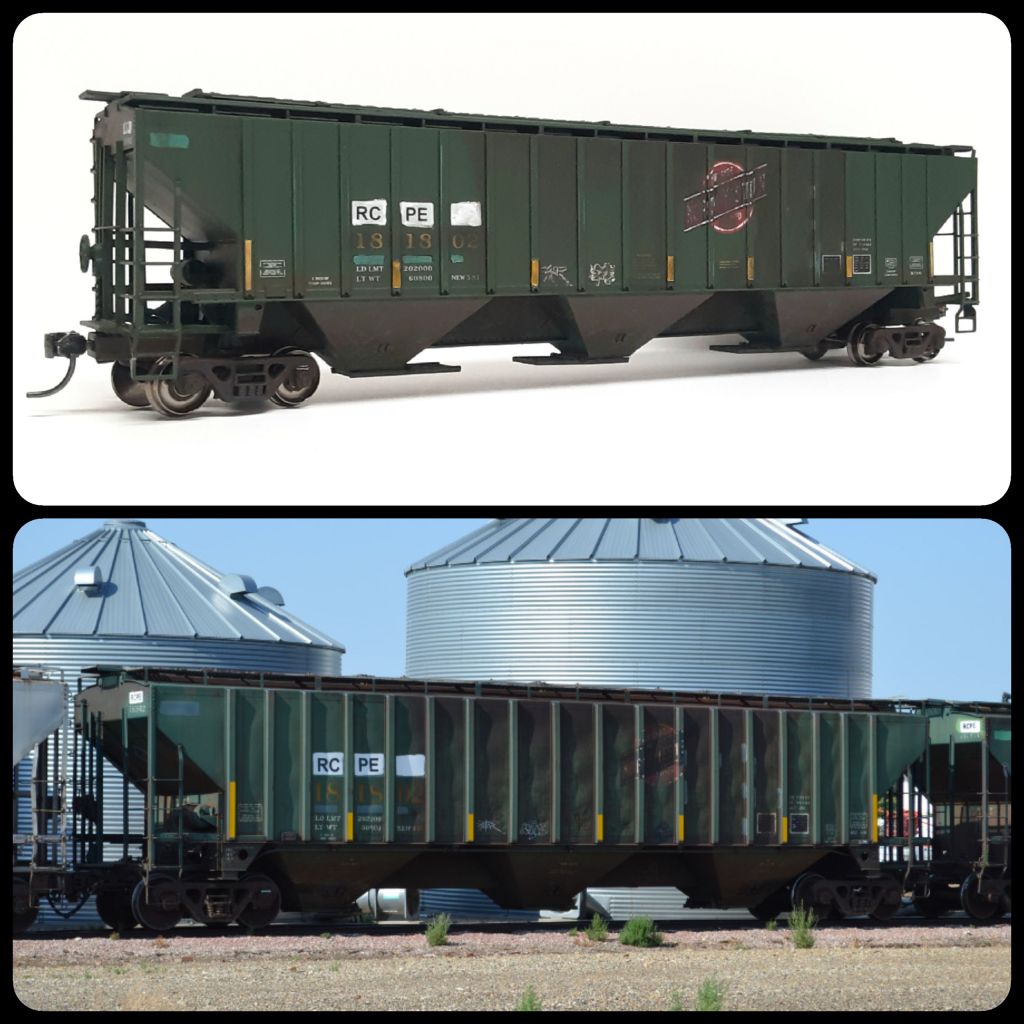
    I was asked to weather this car for my local hobby shop train guy. Since it’s a local road to us, he asked to go as prototypically as possible.

    OVERVIEW:

    A quick backstory on these Accurail cars – A few of my local modeler friends and fellow club member put in the time to have Accurail produce a minimal run of these hoppers in ex-CNW factory patched for RCPE (Rapid City, Pierre & Eastern – formerly DME) which is our local road. Knowing the folks behind this made this project a little more special.

    My process:

    I looked for a prototype photo because the end goal was to get as close as possible. Thanks to rrpicturearchives I found one before the site became wonky. There was something off between the cars but I couldn’t figure it out until I finally noticed the conspicuity stripes differed than the factory printed ones. That had to change, at least on the one side.

    My first step is almost always the same, I sprayed the car with Tamiya TS-80 flat clear to give the surface some tooth to hold powders.

    To remove the printed stripe I used 600 grit sand paper and slowly sanded them off. I used a super fine microbrush to apply some thinned Testors yellow enamel to replace the stripes. If I was to do it over, I would use Humbrol 99 matte yellow to get a closer match with the factory stripe color. However, the shade is virtually not noticeable after powders were applied.
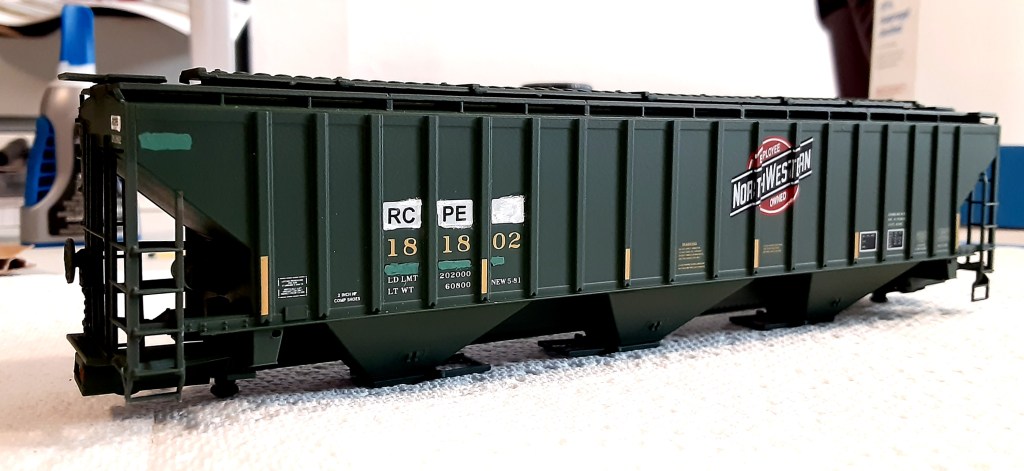
    I next mixed up a small amount of an off-green color for the small patches below the road numbers and top corner of the side panel ends on each side. I used basic white and dark green acrylic craft paints to make the color. To apply the small patches I used a super fine microbrush, that had been previously used and I was able to remove the bristles easily to make a very fine point plastic applicator. Steady hands helped paint the patches. When they dried I used a #11 Xacto blade to gently scrape the edges square.

    I cleaned up my plastic applicator made from the microbrush and applied a sheer coat of white craft paint around the reporting mark letters on the factory RCPE patches to create the imperfect look from the prototype image. Patience is definitely key while building up the paint to get the effect.

    While I had the white paint going, I used the same applicator to hand draw the two small tag marks along the lower sill. I initially went too heavy, to correct that I went over the paint slowly with a #11 Xacto blade until I was happy. The second is just a bit taller than the prototype.

    Wanting to let the paints fully dry, I turned to the hoppers next. I sprayed some RustOleum ultra flat camo brown on a cottonball and into a small paint cup for use later. I used the paint saturated cottonball to blot on some of the dark brown flat paint, this creates a randomized splatter pattern. I went around the hoppers then followed up with a Q Tip dipped in the paint cup of the same paint. I applied more in random blots where my cottonball couldn’t reach.

    Once the applied paints had dried, I used A.I.M. dark earth powder and stippled in on the hoppers over the dry paint. This resulted in a layered effect with some texture. I worked the powders until satisfied with pattern and look. I also used the A.I.M. dark earth powder to create the wheel spray up the car ends.

    I went back to the prototype image and began with the CNW logo, it needed to be faded. I used 600 grit sand paper to slowly take away the printed layers until it resembled the prototype image look. Then I started adding Bragdon soot powder to the car side in a similar pattern to the image. I had to use soot because the brown looked too brown against the dark CNW green. I was cautious to keep the powders off tge patches as the image shows they are relatively clean.
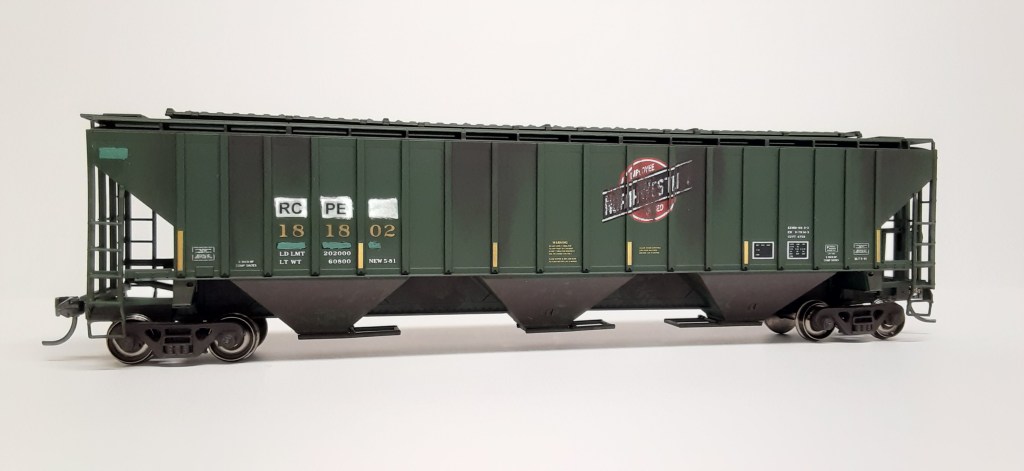
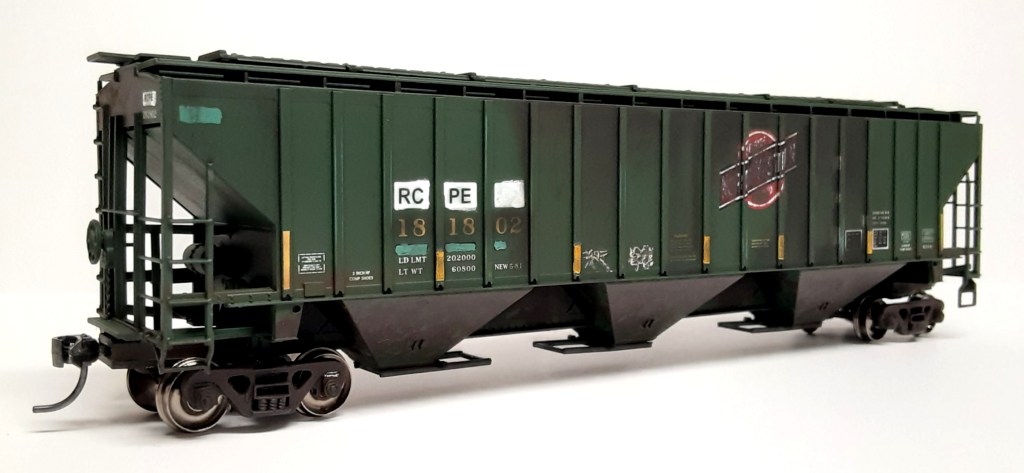
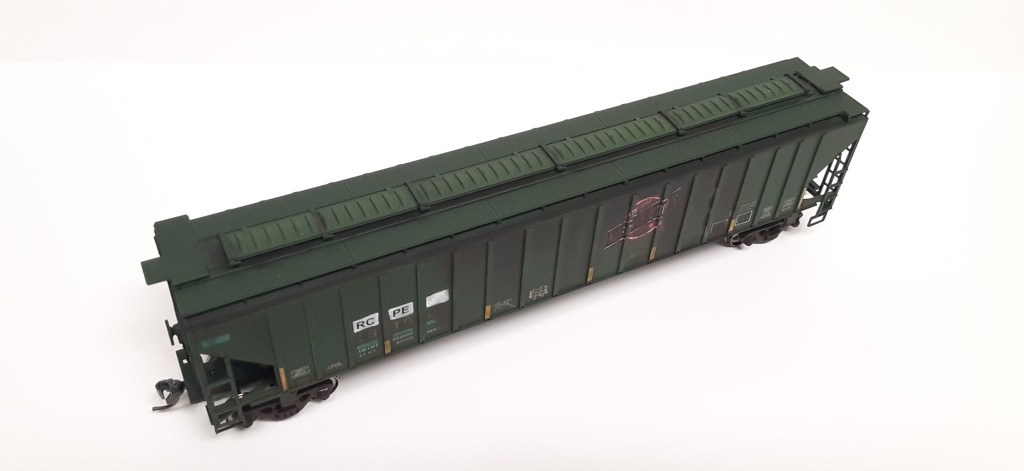
    Now that the sides and ends were done I moved to the hatches and top. More Bragdon soot was applied along the flat surfaces, while the hatches received a medium dusting of Bragdon green grunge powder along with dark earth powder accents across the hatches. Unfortunately the green looks good in person as a subtle sun faded look, but the effect does not come across in photos well.

    Now that I was happy with how the car looked I sealed everything with another medium coat of Tamiya TS-80 flat clear.
    FINAL TOUCHES:

    While the car body dried, I masked the back sides of the trucks and sprayed the faces with the same ultra flat camo brown RustOleum paint used underneath. This helps pull the trucks and underside together. I did not paint the wheels per the request of the car’s owner.

    I reassembled the couplers and trucks then mounted them on the car and I called it good. Overall I’m happy with how this car came out, I always find a couple things to do differently on the next project and some new ideas will come to the surface too.

  • Model Train Podcasts: What do I listen to?

    TV killed the radio, or so they say. But what if radio didn’t die, it just moved online? That is essentially the concept behind a podcast. They can be live or prerecorded. They can be audio only or they can be videos. However, all podcasts share the same basic concept; individuals making their own radio show that can be shared across the world through the internet.

    One advantage podcasts have over traditional radio is that a podcast can be about almost anything. There are 4.4 million registered podcasts globally as of 2025 and is not a $3 billion dollar industry. Podcasts are growing in popularity as well since people can listen to conversations about their favorite subjects anytime they want. Podcasts offer the same benefits for model railroaders as well. Obviously, there’s not enough time in the day to listen to every minute of every podcast on a relevant subject. That’s why in this article I’d like to briefly explain three podcasts which I regularly listen to; The Around the Layout Podcast, What’s Neat with Ken Patterson, and the Second Section Podcast.

    Hosted by Ray Arnott and Don Irace along with Paul Cassar acting as the producer, the “Around the Layout” podcast was created as a way to connect with people in the hobby in the post-pandemic era. Based out of New England, the Around the Layout Podcast has been going strong now for over two years putting out audio podcasts about once per week. Each episode is between a half hour and an hour in length, making these podcasts perfect for a commute to work or for easy listening while at the workbench on a Friday night. Since this podcast is audio-only, the files are easy to download and listen to later. Using the Facebook pages as a metric, the Around the Layout podcast has an audience of between 1,500 and 2,500 people.

    The original model railroad podcast, Ken Patterson has been producing “What’s Neat” for over a decade. Originally, “What’s Neat” started as a monthly video produced by Ken Patterson for the digital-only Model Railroad Hobbyist magazine. As the segment gained popularity with readers, these “What’s Neat” segments became longer and more detailed. About seven years ago, “What’s Neat This Week” became a separate podcast on Ken Patterson’s Youtube channel. Ever since, new episodes have been coming out once or even twice a week alongside video segments for MRH magazine every month. All in all, Ken has put a lot of work into making what is easily the biggest model railroading podcast out there.

    Viewership for podcasts are several thousand while MRH magazine’s segments get 10-15k viewers each month. Size isn’t everything, but it is indicative of the podcast’s quality. Ken makes an effort to get multiple guests on per month and has a rotation of different segments and even videos in the field from large events in the Midwest. Since the podcasts are all video-oriented, they are more difficult to listen to while driving or on the go, but they can be downloaded for things like airplane flights, riding shotgun in a car to the next train show, or while sitting at the workbench at home. What I especially like about “What’s Neat” is the emphasis on how-to subjects and other information which is difficult to communicate via articles.

    Hopping on the bandwagon about three years ago, two Wisconsinite model railroaders, Andy Dorsh and Mike Ostertag decided to launch a long-format livestream podcast that has proven to be a very successful formula for model railroaders. In its current format, each episode is approximately two hours long and goes live every other Thursday. Episdoes feature either one big-name guest like Lance Mindheim or several model railroaders. I myself have appeared in one episode and a “brew with the crew” special this past winter.

    If you are looking for a podcast to sit and listen or watch for a long, uninterrupted period of time, The Second Section is precisely what you are looking for. Between the helpful advice and the intriguing discussions, there is also a kind of camaraderie that is rarely seen in online communities. The “section crew” currently boasts over 1,600 members on Facebook. Each livestream regularly gets about 160 people tuning in and then after the fact it is not uncommon for episodes to surpass 3,000 views on the Youtube channel alone.

    So, which one is the best?

    At the risk of delivering a cop-out answer, the honest truth is that it depends. If you like watching videos, then “What’s Neat” and “The Second Section” are going to be the obvious choices. If you don’t have a spare two hours to sit down and listen to model railroaders talk about their hobby then the “Second Section” isn’t going to be for you. If you are looking for clear how-to presentations, then Ken Patterson has you covered with both his podcast and the MRH monthly videos he produces. My recommendation is to give each one a try and then pick one to focus on. For me, that is the Second Section because Andy and Mike are delivering content at such a rate that I can barely keep up. The online community is very supportive as well and fun to be involved with.

    Whichever one you go with, one thing I do want to mention before closing this essay out is that each of these podcasts rely on community support in order to stay in operation. If you are a regular listener, have a few spare dollars, and know where to send the money then please give them a tip. Podcasts are just one piece in a much larger hobby, but that piece is key to moving away from traditional media formats and building an online community for all model railroaders.