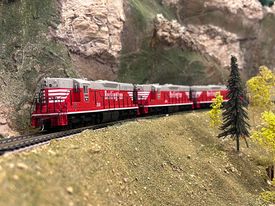
The two most popular model railroading scales in North America are HO (1:87) and N (1:160). HO scale still dominates the market but in recent years N scale has been growing substantially in popularity. If you are new to the hobby then it is likely that you are trying to decide which one of these scales to invest in. This article will provide a brief description of both scales as well as key questions to ask yourself in deciding between N and HO scales.
HO Scale vs N Scale
Sized at 1:87th and with a standard gauge of 16.5mm, HO is the most popular model railroad scale on the market today. Almost every locomotive and car that rode the rails from the 1890s to present day can be found in this scale which makes finding and purchasing models that match your prototype straightforward. Many modelers find 1:87 to be in the “goldilocks zone” for modeling short lines and branch lines in a modest space. However, one disadvantage to HO scale is that for a lot of modelers the scale is too large to realistically model mainline running on Class I or Class II railroads. Because of this, there has long been a desire by model railroaders to fit a longer mainline run into a given space and this is where N scale really shines.
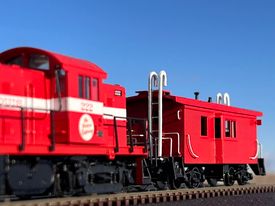
Sized at 1:160th scale, N scale is roughly half the size of HO scale. Structures take up one fourth the area and layouts can be built in very small spaces. Alternatively, N scale can be used to model a much larger section of a railroad than HO scale if the space remains the same. This makes running mainline class I trains much more accessible. A big gap between the two scales used to be in the detailing possible. HO scale had a reasonable level of detailing on equipment yet N scale was traditionally too small to achieve the same amount of detail. This gap has narrowed significantly in recent years and now N scale detailing rivals that of HO scale.
N scale modelers were slower to adopt DCC due to the size of the electronics needed to be fit inside locomotives, but today that is no longer an issue. One area that is still troublesome is in the lack of coupler standardization. Truck-mounted couplers are quite common still on rolling stock even though such designs are almost extinct in HO scale. Additionally, most manufacturers have their own N scale coupler which may or may not be compatible with other brands.
Deciding on a Scale
It is wise to pick a scale to model prior to purchasing a large amount of equipment. If you already have a strong preference for one or the other, then roll with it. But if not and you are stuck deciding between N scale and HO scale, considering the five following questions:
- What is my prototype? If you like running long trains on a mainline then N scale’s smaller size has several advantages. However, if you like to run trains at slow speed and switch out industries, then HO scale tends to run smoother, slower, and more realistically.
- How much space do I have? Equally important is the amount of space available. Do you have one or two walls to build a switching layout or can you use the whole bedroom? How about the whole basement? The garage? If you have the space to model what you want in HO scale, then it will be more convenient to do so. However, if you have some space constraints then N scale will adapt better to tight spaces.
- Are the models I want available? This is also an important one. The good news is that just about every 2nd or 3rd generation mainline diesel locomotive that runs on US rails can be found in both N scale and HO scale. The bad news is that N scale model availability isn’t as good as HO scale for unique models. Check out what’s available to model your prototype before making a decision.
- Can I see and work on the models? Everybody is different when it comes to eyesight and dexterity. Someone with nimble fingers and keen eyes will likely do just fine in keeping their N scale fleet running well. However, not everyone has perfect vision and with age comes a tendency for eyesight and hand-eye coordination to deteriorate. If you want to be modeling in the same scale 30 years from now, would be wise to invest in a larger scale now.
- What is my budget for building materials? The amount of benchwork, foam, scenery supplies, light fixtures, and more that are required to build a model railroad is determined by the type of layout being constructed and the scale being selected. Smaller scales will use less materials overall, so if you are on a budget it might be wise to build the layout that you are envisioning but in a smaller scale.
Conclusions
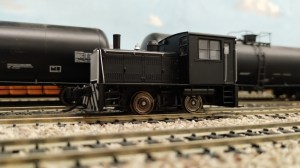
Remember that these questions are what I consider to be important. While I hope you will also take these points into account when deciding on which scale to use, it is ultimately personal preference. One of the site’s contributors, Jordan Schmieg, has built a fantastic layout of the Milwaukee Road in his area. I personally still feel that N scale would have given him certain advantages to replicating the town of Andover and mainline operations, but Jordan wanted to stick with his HO scale because that’s what he had and the availability of unique models to the Milwaukee Road just isn’t there in N scale. So he built himself a model railroad that he is happy with and that’s the important thing.
